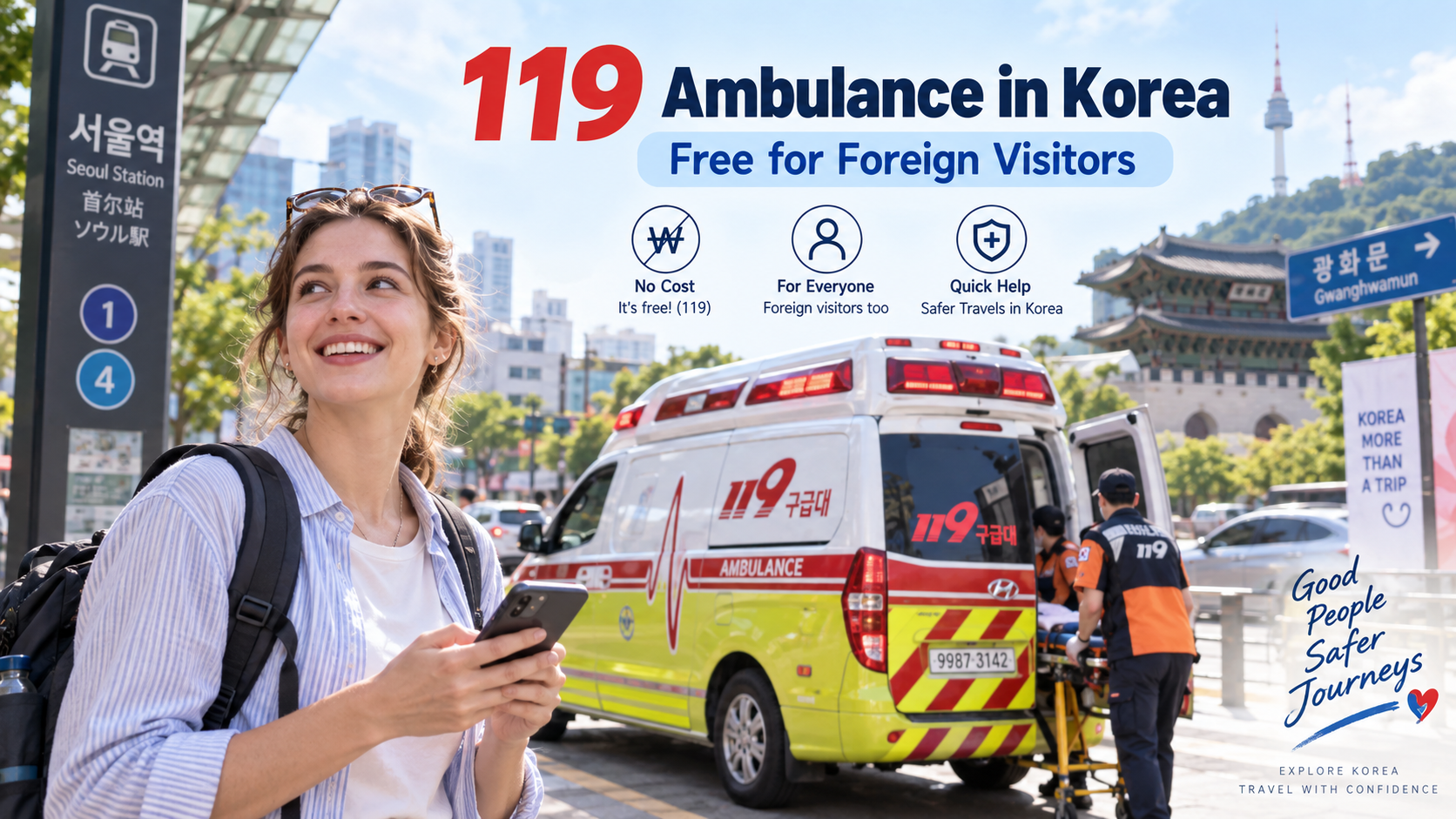
Is the 119 Ambulance Free in Korea? What Foreign Travelers Need to Know
Imagine suddenly becoming seriously ill or getting injured while traveling in Korea.
You know you should call an ambulance, but one thought may stop you:
“How much will the ambulance cost?”
For travelers from countries where an ambulance ride can result in a large medical bill, this is a very reasonable concern.
Here is one important thing every international visitor to Korea should know:
Calling 119 and using a public 119 ambulance in Korea is free of charge. This also applies to foreign visitors.
However, there is an important distinction: the ambulance service may be free, but medical treatment at the hospital is not.
Here is how Korea's emergency system works and what foreign travelers should do when they need urgent medical help.
1. What Is 119 in Korea?
In Korea, 119 is the emergency number for fire, rescue, and emergency medical services.
If someone is seriously injured, unconscious, having difficulty breathing, experiencing severe chest pain, suffering from a severe allergic reaction, or facing another potentially life-threatening situation, call 119.
You do not need to add an area code when calling from a phone in Korea.
☎ 119
Fire · Rescue · Ambulance
The 119 system is operated by Korea's fire and emergency authorities and can dispatch emergency responders and a public ambulance to your location.
2. Is a 119 Ambulance Really Free for Foreign Tourists?
Yes.
Korea's public 119 ambulance service is free, and foreign visitors can use the service as well.
You are not charged simply because an emergency ambulance comes to your location and transports you to an appropriate hospital.
This can be especially surprising for travelers who come from countries where an ambulance ride may result in a substantial bill.
Most importantly, travelers should not delay calling emergency services because they are worried about the cost of a public 119 ambulance.
119 public ambulance = Free
Hospital treatment = Not necessarily free
3. The Hospital Is NOT Free
This is the part travelers must understand clearly.
The free 119 ambulance service does not mean that your entire emergency medical visit will be free.
Once you arrive at a hospital, you may be charged for services such as:
- Emergency room care
- Doctor consultations
- Blood tests
- X-rays, CT scans, or other imaging
- Medication
- Medical procedures
- Surgery
- Hospital admission
Short-term foreign visitors are generally not covered by Korea's National Health Insurance simply because they are visiting the country.
For this reason, travel insurance is highly recommended before visiting Korea.
If you have travel insurance, keep your insurance company's contact information and policy number somewhere easily accessible on your phone.
4. What If You Cannot Speak Korean?
Do not let language worries stop you from calling 119 during a serious emergency.
Korea provides assistance for foreign-language emergency calls.
When your call connects, you can say:
or
“Interpreter, please.”
The emergency operator can arrange interpretation assistance so you can communicate important information.
When possible, speak slowly and clearly.
5. Your Location Is Extremely Important
When calling 119, one of the first things emergency responders need to know is where you are.
This can be difficult for travelers who do not know Korean street names.
If you cannot explain the address, look for:
- Your hotel name
- A nearby subway station
- A convenience store or major building
- A tourist attraction
- A road sign
- Your smartphone map
If you are staying at a hotel, guesthouse, or Airbnb-style accommodation, save the Korean address on your phone before going out.
A screenshot of your accommodation's address can be surprisingly useful in an emergency.
6. When Should You Call 119?
119 is intended for genuine emergencies.
Call 119 when someone has symptoms such as:
- Severe difficulty breathing
- Loss of consciousness
- Severe or sudden chest pain
- Signs of stroke
- Severe bleeding
- Seizures
- Serious injuries after an accident or fall
- A severe allergic reaction
- Sudden serious illness
- Any situation where someone's life may be in danger
If you simply have a mild cold, minor headache, indigestion, or another non-emergency condition, a pharmacy, clinic, or late-night medical facility may be more appropriate.
7. Public 119 Ambulance and Private Ambulance Are Different
This distinction is also important.
When people say that ambulances are free in Korea, they are referring to the public 119 emergency ambulance service.
Ambulances operated by hospitals or private medical transport companies are different and may charge transportation fees.
Therefore:
| Service | Cost |
|---|---|
| Public 119 emergency ambulance | Free |
| Hospital/private ambulance | Fees may apply |
| Emergency room treatment | Medical fees apply |
8. Should You Worry About Calling 119 Because You Are a Foreigner?
No.
Foreign visitors can call 119 when they are experiencing a genuine emergency in Korea.
The National Fire Agency has specifically provided information and emergency services for foreigners, and Korea's tourism authorities also advise international travelers to use 119 for fire, rescue, and medical emergencies.
Your nationality should not make you hesitate when immediate help is needed.
9. Another Helpful Number: 1330
Not every medical problem requires an ambulance.
For travelers who need general travel assistance or interpretation help, Korea also operates the 1330 Korea Travel Helpline.
This can be helpful when you are trying to find information, locate appropriate services, or deal with a non-life-threatening travel problem.
🚑 Medical emergency / Fire / Rescue: 119
👮 Police emergency: 112
ℹ️ Korea Travel Helpline: 1330
For a true medical emergency, however, call 119 first.
10. A Simple Emergency Checklist for Travelers
Before traveling around Korea, take five minutes to prepare:
- Save 119 in your phone.
- Save the Korean address of your hotel or accommodation.
- Keep a photo of your passport available securely.
- Save your travel insurance information.
- Keep a list of medications you take regularly.
- Write down any serious allergies.
- Remember the phrases “English, please” and “Interpreter, please.”
These simple steps can make a stressful emergency much easier to handle.
Final Takeaway
One of the reassuring things about traveling in Korea is that you do not have to calculate the cost of a public ambulance before asking for emergency help.
If you face a genuine medical emergency, call 119.
The public 119 ambulance service itself is free, including for foreign visitors, and interpretation assistance is available for travelers who do not speak Korean.
Just remember the important difference:
Hospital examination and treatment: NOT FREE
Private or hospital ambulance: MAY COST MONEY
Hopefully, you will never need to use 119 during your trip.
But knowing that help is available — and knowing that you can call without worrying about an ambulance bill — can provide valuable peace of mind while traveling in Korea.
Save 119 before your trip. In a real emergency, getting help quickly matters far more than trying to solve the situation alone.
※ This article provides general travel and emergency information. Medical treatment costs vary depending on the hospital, treatment, insurance status, and individual situation. In a serious or life-threatening emergency, contact 119 immediately.


