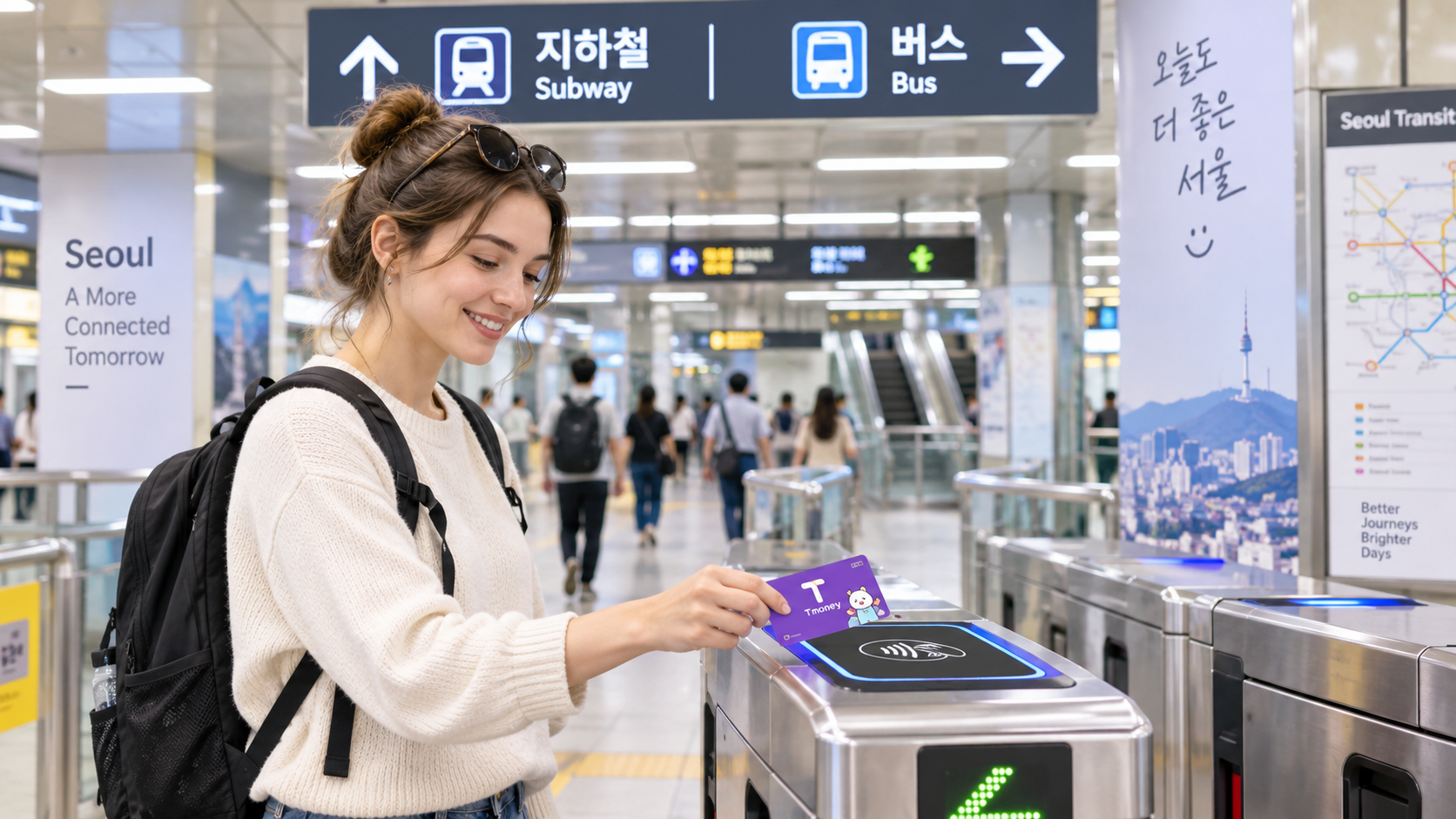
🇰🇷 How to Use T-money in Korea: A Simple 2026 Guide to Subways, Buses & Transfers
If you are traveling in South Korea, one of the first things you should get is a T-money card. It makes using subways and buses much easier, and you will not have to buy a new ticket every time you travel.
For first-time visitors, however, questions quickly appear: Where do you buy a T-money card? Can you recharge it with a foreign credit card? Do you need to tap when leaving a bus? And what happens when you transfer from a subway to a bus?
This simple 2026 guide explains everything you need to know before using public transportation in Korea.
1. What Is a T-money Card?
T-money is a rechargeable transportation card widely used throughout South Korea. You load money onto the card in advance and simply tap it on a card reader whenever you use public transportation.
You can use T-money on many types of transportation, including:
- Subways
- City buses
- Many airport and local buses
- Many taxis
- Some intercity transportation services
T-money can also be used at many convenience stores and other participating stores displaying the T-money logo.
2. Where Can Foreign Travelers Buy a T-money Card?
T-money cards are easy to find after arriving in Korea.
You can normally buy one at major convenience store chains such as:
- CU
- GS25
- 7-ELEVEN
- emart24
They are also available at selected subway station service centers.
A basic T-money card usually costs around KRW 3,000–5,000, depending on the card design. Special character or souvenir versions may cost more.
The purchase price of the card does not normally include transportation credit, so remember to add money before using it.
3. How Do I Recharge a T-money Card?
You can add money to your T-money card at convenience stores and subway stations.
At a convenience store, simply give the card to the cashier and say:
“T-money charge, please.”
You can also show the amount you want to add on your phone if communicating in Korean is difficult.
For example:
“20,000 won, please.”
Do not assume that your overseas credit card can be used to recharge a regular T-money card. For a standard prepaid T-money card, carrying some Korean cash is still the safest option for purchasing and recharging.
4. How to Use T-money on the Subway
Using the subway is very simple.
- Find the subway entrance for the correct line.
- Tap your T-money card on the card reader at the ticket gate.
- Take the subway to your destination.
- Tap the same card again when exiting.
The correct fare is automatically deducted based on your journey.
You do not need to calculate the fare yourself.
5. How to Use T-money on a Bus
When boarding a bus, enter through the front door and tap your T-money card on the card reader near the driver.
Before your stop, press one of the red stop buttons inside the bus.
When leaving, tap your T-money card again on the reader near the exit door.
This second tap is very important.
It allows the transportation system to calculate the correct fare and helps you receive transfer discounts when changing to another bus or subway.
6. Don't Forget to Tap When You Get Off the Bus
Many visitors remember to tap when they get on but forget to tap when getting off.
That can cause problems with transfer discounts and fare calculations.
So remember this simple rule:
Subway: Tap IN → Tap OUT
Bus: Tap ON → Tap OFF
Making this a habit will make traveling around Korea much easier.
7. Bus-to-Subway and Subway-to-Bus Transfers
One of the biggest advantages of using a transportation card is Korea's integrated transfer system.
When you transfer between eligible buses and subways within the allowed transfer period, you generally do not pay a completely new base fare each time. Instead, the system calculates the combined journey and may charge only an additional amount depending on distance and transportation type.
This is why tapping your card when leaving a bus is so important.
In Seoul, transfers generally need to be made within a limited time after getting off, and repeated use of the same bus route does not qualify as a normal transfer.
8. How Much Does the Seoul Subway Cost?
For adults using a transportation card, the standard Seoul subway base fare is currently around KRW 1,550, with additional charges possible for longer-distance journeys.
A single-journey subway ticket generally costs slightly more than using a transportation card.
Because transportation fares can change, it is always a good idea to check the latest fare information before your trip.
9. What If I Don't Have a T-money Card?
You can still use the Seoul subway without T-money.
Single-journey tickets can be purchased from ticket machines inside subway stations. Many machines provide English and other language options.
As of 2026, new ticket machines at many Seoul Metro stations on Lines 1–8 also accept internationally issued credit and debit cards for single-journey tickets.
However, a single-journey ticket is mainly useful for occasional subway trips. If you plan to use buses and subways frequently, T-money is usually much more convenient.
10. T-money or Climate Card: Which Is Better?
Travelers staying mainly in Seoul may also see something called the Climate Card.
The short-term Climate Card offers unlimited use of eligible Seoul public transportation for a fixed period. Short-term options include:
- 1-day pass
- 2-day pass
- 3-day pass
- 5-day pass
- 7-day pass
For tourists taking many subway and bus rides every day, a short-term Climate Card may be worth comparing with T-money.
If you are traveling outside Seoul or moving between several Korean cities, a normal T-money card is often the simpler and more flexible choice.
Traveling all over Korea → T-money is usually more flexible.
Traveling heavily within Seoul for several days → Check the Climate Card.
11. Can I Use My Foreign Credit Card Directly on Subway Gates?
Do not assume that you can simply tap your foreign Visa or Mastercard directly on every subway or bus gate in Korea.
Korea is gradually expanding payment options for international visitors, but regular T-money and other Korean transportation cards are still the most reliable way for travelers to use buses and subways.
Some newer ticket machines support overseas cards for purchasing single-journey tickets or certain tourist transit passes, but this is different from directly tapping your overseas bank card at every subway gate.
12. What If My T-money Balance Is Too Low?
If there is not enough money on your card, the gate may not open or the bus reader may display an insufficient balance message.
Simply visit a subway recharge machine or nearby convenience store and add more money.
For a short trip, keeping around KRW 10,000–30,000 on the card at a time is usually easier than loading a very large amount. You can recharge again whenever necessary.
13. Can I Get My Remaining T-money Balance Back?
Yes. Small remaining balances can generally be refunded at participating convenience stores and T-money service locations. A small service fee may apply depending on the refund method and amount.
If only a small amount remains before you leave Korea, another easy option is to use the balance at a participating convenience store.
Quick T-money Checklist for First-Time Visitors
- ✅ Buy a T-money card at a convenience store
- ✅ Keep some Korean cash for regular T-money recharging
- ✅ Tap when entering the subway
- ✅ Tap again when leaving the subway
- ✅ Tap when boarding a bus
- ✅ Always tap again when getting off the bus
- ✅ Use the same card throughout your journey
- ✅ Compare the Climate Card if you will travel heavily within Seoul
Final Tip
Korea's public transportation system may look complicated during your first few hours, especially when you see multiple subway lines, bus colors and station exits.
But once you have a T-money card, transportation becomes surprisingly simple.
Buy it, recharge it, tap in and tap out.
After a day or two, you will probably be using Korean subways and buses like a local.
Have a safe and enjoyable trip to Korea! 🇰🇷


